Tuesday, July 18, 2017

We are ‘aisich’


Hyderabadis are going nuts over Deccani khabarnama
No news is good news. But there is no solace in this saying anymore. With disturbing tidings pouring in by the minute — strife, economic meltdown, unemployment, rising crime — there isn’t any comforting news these days. But trust Hyderabadis to come up with the unpleasant news with a touch of humour. Even hard news goes soft when presented in the typical Deccani dialect. Sample this: “UP ke ek gaon main shadi ke dinich dulhe mian ko gutka khareso dekh kar shadi se inkar….”

That was a recent ‘khabarnama’ in pure Deccani style on a bride’s refusal to marry after she caught the groom chewing gutka on the wedding day in a UP town. The TV anchor leaves you in splits by the time she finishes with the 20-minute bulletin. As viewers hang on, more interesting details emerge.

“Pehle kali, moti, nati, giddi hai bol ke rasam bhi tod dete they aur ye ladki ke vaste bahut kharab baat hoti thi. Aaj ke daur main dulhana shadi tod derain. Dulhe ko gutka chabate dekh kar dulhan shadi nai karti bol di aur zid pe ad gayi...”.

From serious to trivial – all news gets the same funny treatment at the Real TV news channel. This is perhaps in keeping with the take-it-easy attitude of Hyderabadis. However serious the situation might be, a true blue Hyderabadi will advice, ‘light le baap’.

Short video clips of Deccani khabrain are going viral on social media as people forward them to their friends.

The other day news of a three-year old girl shedding tears of blood was related with the same comic touch without compromising on the seriousness of the incident. “Roye to aur hanse to aankhon se aansu nikalte so aap logan dekhe honge magar ek teen sal ki ladki ke ankh, kan aur jisam se khoon nikalra katey...”.

The fun laced news bulletin in real ‘Hyderabad zaban main’ doesn't come as a surprise. Be it serious political developments or parliamentary debates the news gets the suffix ‘katey’ (seems). “Telangana ke Congress leadaran sadarati umidvar, Meira Kumar, ka Shamshabad airport pe zabardast welcome kare”, the anchor goes on about the recent visit of the UPA’s presidential nominee to the state. Another piece of Deccani news has interesting take on the ongoing Harita Haram programme. “Aap logan ko maloom hai mahol ko hara bhara karne ke liye Telangana hukumat ke taraf se paude lagarein..”

A report on construction of two bedroom houses in the city brings chuckles. “RDO Chandrakala Ghode-ki-khabar ke pas double bedroom gharan ke bare main survey kare..”

Why should news always be a serious affair and presented in a monotonous flat tone? Shareef Abdul Rahim Yamani has successfully broken this stereotype by coming up with the Deccani khabarnama. When the idea of news in Deccani dialect was mooted way back in 2013 everyone laughed it off.

It is one thing to talk in everyday Deccani language and another to present news in it. One cannot maintain the seriousness of the news, it was felt. But Yamani persisted with the concept. “When Deccani can be the language of poetry, novels and films like The Angrez and Hyderabad Nawabs why it can’t be used for presenting news,” says Feroze Suri, filmmaker who is also associated with Real TV.

Apart from Hyderabad and Telangana, a large number of people in the erstwhile Nizam domain speak Deccani with slight variation. They feel at home and instantly connect with the Deccani khabarnama. But it took six months of intensive planning and rehearsal of news presentation in Deccani language before the ‘apnaich channel’ went on air. The khabarnama is aired at 8.30 p.m and repeated four to five times in 24 hours.

No, the stress is not on breaking news but on infotainment. “We seek to inform and entertain on various issues,” says Suri.

Infotainers Ayesha Butool, Syed Ahmed Ali and Sanober are a big hit with the audience because of their Deccani diction. The humour quotient is provided by the bespectacled Syed Kazim who gives the distinct Deccani flavour that draws instant laughter.


- J.S.Ifthekhar,
Hyderabad based journalist.

Article published in The Hindu
Dated July 18,2017.

Tuesday, July 11, 2017

Serving crunchy treat


Best known for its Osmania biscuits, Subhan bakery is now getting trendy
Happiness is only a biscuit away in Hyderabad - an Osmania biscuit to be precise. One bakery which takes the credit for this has gone for an image makeover. A double delight indeed.

Now you don’t need to jostle or elbow around to get your favourite cookie. The ambience of Subhan Bakery poast makeover is refreshingly airy and spacious. One of the oldest bakeries in the city has now turned into a sort of large upmarket retail store where you make your purchases at a leisurely pace. In terms of its yummy goodies too, it has gone in for a major expansion offering 60 varieties of biscuits, cakes, toasts, rusks, curry puffs, breads, pastries, pizzas and burgers, all in tune with changing trends.

But the USP of Subhan bakery remains Dum ke Roat and Osmania biscuit. The latter named after the 7th Nizam, Mir Osman Ali Khan, is the fastest moving product on the shelf. People from all over the city and nearby districts drop in here just to get the Osmania biscuit, a product popular both among the commoners and elite. The loyalty and support Subhan bakery enjoys from its customers is phenomenal. Don’t be surprised if you find junior film artists, doctors and politicians queuing up for it. Film producer, Dasari Narayan, had been a great fan of this biscuit. Hyderabad MP, Asaduddin Owaisi, gets the crispy biscuits from Subhan and so does the megastar Chiranjeevi. When the State legislature is in session, the law makers get their crunchy treat from here. Osmania biscuit and Irani chai - can a true blue Hyderabadi do without them?

Dum ke Roat is another crusty fare that is a big hit with customers. Essentially sought after during Muharram, the first month of Islamic calendar, it is now available even after the month of mourning is over. The main ingredients are: wheat flour, sooji (semolina), vegetable oils, sugar, honey, clarified butter, salt, and cardamom and milk products.

For added flavour it is decked with dry fruits such as almonds, cashew nuts, pista and saffron. But getting all these in the right proportion is the most important aspect. The duration of baking is what lends that brownish look while making it crunchy from outside and soft within. What’s more, Roat is made of pure ghee and is 100 percent vegetarian.

So where is the Subhan bakery? Once you land in Nampally trust your olfactory glands to guide you to it. Yeah, much before you set eyes on the bakery you smell it. Passersby couldn’t miss the fragrance of freshly baked biscuits wafting in the air.

All the fame this bakery enjoys is because of Syed Khader who named it after his son, Syed Subhan, in 1951. The bakery had been running without any name since 1948 from a cramped shop in Red Hills. “My grandfather sacrificed his time, family life, leisure and luxury to build the bakery,” says Syed Irfan, who now runs the bakery along with his younger sibling, Syed Imran. So while the bakery has existed in the present form for the last 69 years, the family has actually been running the enterprise for over a century.

Now in the seventh generation, it is leveraging technology to boost its products. The four-storied bakery is home to imported machines from Germany and Italy to dish out biscuits, breads and cakes in a jiffy. The formula which whips up the unique taste of course remains a closely guarded secret. Subhanallah!


- J.S.Ifthekhar,
Hyderabad based journalist.

Article published in The Hindu
Dated July 11,2017

Sunday, June 25, 2017

CiNaRe, an Urdu poet in his own right

CiNaRe with Chief Minister K Chandrashekhar Rao.

He who can write. He who can’t criticise. He belonged to the first category. Poet, lyricist, playwright, educationist, administrator, Rajaya Sabha member — a truly multifaceted personality. But, not many know that Dr. C. Naryana Reddy was also an Urdu poet in his own right. In fact, he made people go wah wah over his Urdu ghazals.

CiNaRe, as he was popularly called, seized life by the poetic side. For him, poetry was not the purpose, but a passion. Like the kavi sammelans, he also set afire the mushairas with his soul-stirring verses. How he turned an Urdu poet is a story by itself. As a famous Telugu poet, he was often invited to chair mushairas. But Dr. Reddy felt uncomfortable being a mere spectator. “I decided to become an active participant and started penning verses in Urdu,” he told this writer a few years ago.

Urdu was not an alien language to him as he had studied up to B.A. with Urdu as medium of instruction. All he needed was just to polish the language and get into the groove. With a little effort he started composing verses with consummate skill.

Ji raha hun mout ko lori sunane ke liye
Kho raha hun mast dhun mein khud ko paane ke liye

Dr. Reddy, who set a new trend in adaptation of Urdu ghazal in Telugu poetry, however, chose to be different in his shayari. He steered clear of ‘ishq-o-muhabbat’ stuff. He did not want to meddle with romance of which Mirza Ghalib and others had written a lot. CiNaRe’s Urdu ghazals revolve around humanism, national, religious and linguistic integration. There is also a touch of optimism in his poetry as this couplet shows:

Bagh mein afwah ke murjha rahen hain phool
Gul huye ghaib, arey phal bun ke aane ke liye


CiNaRe adhered to metre, motif and other rhetorical features of ghazal. His Telugu adaptation of ghazals was also complete with poetic nuances — matla, makhta, khafia, radif and takhallus. For him, writing in Urdu was to satisfy his creative urge.


- J.S.Ifthekhar,
Hyderabad based journalist.

Article published in Telangana Today
Dated June 25,2017.

Monday, June 19, 2017

Minority welfare: Going beyond lip sympathy

Things have started looking up for minorities in Telangana and welfare has taken a new meaning

It has always been on the backburner — neglected and uncared for. There was nothing much to talk about minority welfare in the combined State. Enter the TRS government and things have started looking up for minorities in Telangana. For a change, welfare has taken a new meaning altogether. It has moved beyond lip sympathy to action and implementation.

Action speaks louder than words. The slew of measures taken by the government during the last three years have begun yielding results. However, the full impact of schemes like opening of residential schools, overseas scholarships and TS PRIME for minorities will be known only after some time. But the winds of change can’t be missed. Even the opposition parties reluctantly admit the positive impact the whole thing is having on the minorities.

Paradigm shift

What is significant is the paradigm shift brought about by Chief Minister K Chandrashekhar Rao in his policies towards minority welfare. The response to ground realities is robust and quick. While it has come as a morale-booster to the marginalised sections of society, it is also earning the government immense support and goodwill. The earmarking of a whopping Rs. 40,000 crore in the current year’s budget for welfare and development of weaker sections tells how serious this government is about giving the neglected communities their due. Perhaps for the first time in decades the 14.24 per cent Muslims in the State feel secure and protected. They know they can now stand up and be counted.

Welfare of minorities remains at the core of the TRS government’s development agenda and this is borne out by the schemes initiated in the last three years. Some of the measures include Shadi Mubarak scheme, raising of subsidy component for bankable schemes for minorities, introduction of honoraria for Imams and Muezzins, sanction of Rs. 10 crore for construction of Christian Bhavan in Hyderabad and construction of a facilitation centre-cum Rubaath at Dargah Hazrat Khaja Mohinuddin Chisti at Ajmer in Rajasthan at a cost of Rs. 5 crore.

Bold move

In the combined State, minorities constituted just 11 per cent of the population and government spent Rs. 509 crore on their welfare in 2013-14. After bifurcation, AP earmarked Rs. 371 crore, while Telangana allocated Rs 1,030 crore in its first budget for 2014-15. This was the highest-ever budget for the region. During 2015-16, the minorities welfare budget jumped further to Rs. 1,105 crore. The next budget of 2016-17 saw the figures going up to Rs. 1,204 crore. And this year the budget received a further hike to touch Rs. 1,249.66.

Passing of the legislation hiking the reservation quota for minorities to 12 per cent is by far a bold move. “No government has ever attempted to address the problems of minorities in such a comprehensive way within a short period of time,” says A.K. Khan, Advisor to Government on Minority Affairs.

Game-changer

The game-changer, however, remains the opening of residential schools for minority boys and girls. The Chief Minister has resolved to spend a whopping Rs. 8,000 crore on the schools, something unheard of in the annals of the State. Of the 200 residential schools proposed, half are meant for girls alone. The overwhelming response to the corporate-type schools are expected to change the face of the community in the coming years. Previous governments merely indulged in offering sops but for KCR it has to be a permanent and lasting solution. When 1.35 lakh students come out of these schools there is going to be qualitative change in the lives of the minorities.

If the hiked minority budget gets lapsed year after year and the Minority Welfare Department (MWD) has failed to live up to the expectations the reason is not far to seek. There is hardly any infrastructure or staff to implement the schemes. Statistics show that the Social Welfare Department has a cadre strength of 149 at the headquarters, Tribal Welfare 77 and BC Welfare 64. But the MWD has just 35 personnel, mostly on deputation. When this anomaly was brought to his notice, KCR immediately sanctioned an additional 80 posts. Officials say the department needs at least 250 personnel for effective functioning. The department needs to build a committed workforce which can own up the programmes and implement them with commitment.

CM determined

Think of MWD and what comes to mind is the beleaguered Wakf Board. Over the years it has become a byword for lethargy. The Augean stables have to be cleaned up and the department shaken out of its stupor. Hope with Khan, a retired cop, at the helm, things would straighten out fast.

In the final analysis, any government is as good as the commitment and dynamism of the person who steers it. In one of his addresses in the State Assembly, KCR had quoted a popular Urdu couplet to express his determination to deliver the promises. He said:
Main apne fun ki bulandi se kaam le loonga

Mujhe maqam na do, maqam le loonga

J.S.Ifthekhar,
Hyderabad based journalist.

Article published in Telangana Today

Dated June 19,2017


Sunday, June 11, 2017

Niloufer, the beguiling princess of Hyderabad

Niloufer. The very name evokes divergent images. For some, a bewitchingly beautiful woman’s face which takes away one’s breath away swims into view. And for some others, the image of a hospital where death stalks sends shivers down the spine.

With due apologies to the Bard, there is indeed plenty in the name. Interestingly, the connection between the two is unbreakable. It is 28 years since Princess Niloufer Farhat Begum, the Turkish wife of Prince Moazzam Jah, breathed her last. And strangely, the hospital named after her continues to be in the news for the wrong reasons.

Regal and unattainable like Mona Lisa — out of the reach of ordinary mortals — beauty and brains, fame and fortune, she had it all. With her winsome beauty and coltish charm she lit up the fabulous palaces of the Nizam. This ravishing princess also had a heart that beat for others. When she saw her maid servant, Rafathunnisa, die during childbirth she got devastated. She did not remain content with just sympathizing with the bereaved family but decided to do something for women in general. “Hereafter, no more Rafaths shall die for want of good medical facilities,” she resolved.

This tragic incident led to the establishment of a hospital for women and children which the Nizam, Mir Osman Ali Khan, named after his daughter-in-law. Niloufer used a silver trowel for the ground-breaking ceremony of the hospital on April 29, 1949. June 12 marks the death anniversary of the Princess who gave so much to Hyderabad and womanhood.


Life like no other


NilouferHow about a peep into this royal superstar of awesome dimensions? Daughter of Damaad Salahuddin Bey Moralizada, a prominent member of the Ottoman Court, Niloufer and her cousin, Durru Shehvar, were swept away into royal weddings. While Niloufer got married to Prince Moazzam Jah, the second son of the 7th Nizam, Mir Osman Ali Khan, her cousin entered into wedlock with the Nizam’s eldest son, Prince Azam Jah
.
The weddings took place on November 12, 1931, at Nice in France and were hailed as a ‘union of two great dynasties’ linking Europe and Asia. The coming together of the true blue Ottoman and the Asafia lineages became a talking point in the two continents. Both Niloufer and Durru Shehvar were arguably the most gorgeous women. The former was counted among the ten most beautiful women in the world. Interestingly, both the charming cousins have hospitals named after them in Hyderabad — Niloufer Hospital and Durru Shehvar Children’s and General Hospital.

After marriage, Princess Niloufer moved into Hill Fort with her husband. An Urdu poet of no mean repute, Prince Moazzam Jah organized mushairas almost every day. Fond of a lavish lifestyle, he doted on his wife and got her painted and photographed. Life seemed to be hunky-dory.

While Princess Durru Shehvar came into the family way an year after her marriage and returned to Nice for confinement, it was not the case with Niloufer. In a traditional society she was expected to bear children and her inability to do so put pressure in her marriage and ultimately after 21 years she parted ways with Prince Moazzam Jah in 1952 and moved back to Paris. Later, she married Edward Pope, an American diplomat, in 1963 and died in Paris on June 12, 1989.

Her mysterious appeal and enchanting persona captivated Istanbul, Paris and Hyderabad. Even to this day her violet eyes, perfect features, blue black Circassian hair, creamy complexion and dimples in the cheeks remain the talk of the town. Known for her sartorial taste, the bewitching Niloufer attired herself in the best of dresses. She wore saris designed by Madhav Das and even now the Fashion Institute of Technology, New York, has a collection of her 32 fabulous saris.

Considered a torch-bearer for women’s advancement, Princess Niloufer led an active public life in Hyderabad. She attracted a lot of attention and some of the most famous people were her friends. She was also offered a role in a Hollywood film but turned it down. Along with her fashionable cousin, Princess Durru Shehvar, she dominated Hyderabad’s social circles.

rincess Niloufer was associated with the Red Cross and was also part of the elite Lady Hydari Club. The charming cousins were the cynosure of all eyes. They were at the Malakpet Race Course, graced a number of forums and attracted many European women. While their charity work received the full support of the Nizam, their celebrity lifestyle didn’t go down well with the royal family. When World War II broke out, Princess Niloufer obtained training as a nurse and treated injured soldiers brought here for convalescence.

An epitome of royalty, Princess Niloufer had the glamour of Marlo Mandarin, flamboyance of Princess Diana and beauty of Nargis. A woman of substance every which way, she was one of the rare ones, so effortlessly herself, and the world loved her for it.


- J.S.Ifthekhar,
Hyderabad based journalist.

Article published in The Hindu
Dated June 11,2017.

Wednesday, May 17, 2017

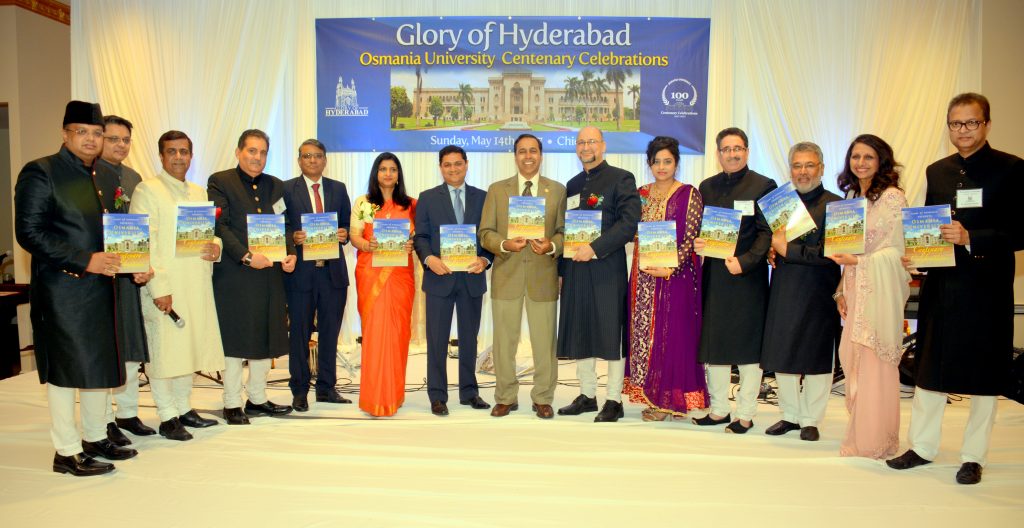
OU fest draws huge crowds in Chicago

ALMA MATER: The programme organised by Glory of Hyderabad drew Osmanaians from all over New York, Houston, San Francisco, Minnesota and Indiana.

Distance makes the heart grow fonder. This can be said about the Hyderabad-based NRIs pining for their alma mater. They might have missed the grand centenary celebrations of Osmania University back home, but they decided to recreate the thrill in their host country.

The other day about 700 Osmanians took time off to attend the OU centenary fest at Shalimar Banquets, Chicago. The programme organised by Glory of Hyderabad drew young and not-so-young Osmanians from all over New York, Houston, San Francisco, Minnesota and Indiana. Incidentally, Glory of Hyderabad, Chicago, became the only organisation outside India to host the first historic event of Centenary Celebration of Osmania University.

It was a trip down the memory lane for some while for others a grand reunion of sorts. What added to the festive mood was an innovative exhibition, an inspiring documentary and an informative souvenir. Many turned emotional recalling their eventful times in the University and their loving teachers and great friends.

Everyone remembered Mir Osman Ali Khan, the 7th Nizam and founder of the Osmania University. There were also references to illustrious alumni like former Prime Minister PV Narasimha Rao, former Lok Sabha Speaker Shivraj Patil, film personality Sham Benegal and former RBI Governor Dr Y V Reddy.

Neeta Bhushan, Consul General of India in Chicago, described OU alumni as the ‘greatest strength’. She called upon them to cultivate the culture of giving back – which is the most rewarding ways to contribute to the betterment of their alma mater.

Professor S Ramachandram, Vice-Chancellor of Osmania University, said that the University had emerged as a pacesetter, becoming an icon of higher learning with international outlook and global outreach. Congressman Raja Krishnamurthy underscored the need for greater collaboration between the universities of India and the US. Hardik Bhatt, CIO, office of the Governor, Illinois, informed that Illinois and Telangana States have signed an MoU to share expertise in the domain of planning and execution of smart cities.


Many Osmanians were honoured on the occasion. Hassan Chishti was given the lifetime achievement award for outstanding community service and literary contribution while Dr MM Taqui Khan was bestowed with the scientist of international repute award. On this occasion, Siasat Calligraphy Exhibition was also inaugurated. Ashfaq Syed, Chairman Steering Committee, Glory of Hyderabad, welcomed the gathering.

J.S.Ifthekhar,
Hyderabad based journalist.

Article published in Telangana Today
Dated May 17,2017

Sunday, February 12, 2017

Architectural marvels of spirituality

Intricate calligraphy dating back to the Qutb Shahi era and contemporary styles all come together in a perfect harmony in the mosques dotting the city. Photo: Surya Sridhar

They stand out for their grandeur, vastness and balance. Ancient mosques of Hyderabad are not just places of worship but spots of tourist attraction as well. While they are symbols of purity, sublimity and one-pointed devotion to the faithful, for others their architectural splendour holds abiding interest.

While Makkah Masjid ranks as one the largest and most eminent of buildings of its class in India, there are many others which are no less magnificent and pleasing to look at. Wonder which is the first mosque of Hyderabad? No prizes for guessing. But it is certainly not Makkah Masjid as is generally believed. It was the Safa Masjid at Golconda, then known as Mohammednagar, which was the first mosque to come up in this region. Golconda, which is impressive even in ruins, holds many an imposing structure. The Safa Masjid is one of them. Built in 1518 AD in Bahmani style by Sultan Quli, it has a large arched hall divided into four aisles.

The date of construction is clearly inscribed in Arabic making it the oldest mosque.

Bygone era

Noted architect Khalid Mohiuddin lifted the veil of secrecy on many a little known thing associated with mosques of Hyderabad. In a scholarly talk recently on “Art and Architecture of historical mosques in Hyderabad’, he transported the audience to a bygone era.

The Jamia Masjid Shujaiya is the first to come up after the Qutb Shahis moved to Hyderabad. This mosque was constructed in 1597 much before Makkah Masjid was built. What is striking about the mosque situated bang opposite Charminar is the minarets. They are in sharp contrast to the Qutb Shahi style of minars which rise into the sky.

 “The minarets of this masjid are deliberately kept short so as not to mar the beauty of the graceful Charminar,” explains Mohiuddin.

The ‘mihrab’ (semicircular niche) in the mosque has Quranic verses inscribed on black basalt in Thulth style by the famous calligrapher, Jalaluddin Muhammed Hussain al Fakkhar of Shiraz. Interestingly, this mosque is now hidden behind modern structures and one has to literally search for it. Another mosque which is also older than Makkah Masjid is the Begum Mosque right opposite it. Calligraphic panels and decorative elements remain intact inside although the exterior has undergone change.


No tall minarets

With arched facades carved out of a single piece of granite, Makkah Masjid is known for its elegant architecture and massiveness. Surprisingly, it is also devoid of tall minarets. The Mughal emperor, Aurangazeb, who completed the construction of Makkah Masjid commenced by Mohammed Quli Qutb Shah, the fifth Qutb Shahi ruler, 77 years earlier, wanted the height of the minarets to be kept low. He wanted things to be done on a smaller scale, it is said.

Nearly 90 per cent of the mosques in Hyderabad were built by the Qutb Shahi rulers, while the Asaf Jahis contributed just 10 per cent. The well-known mosques built by the Nizams are the Chowk ki Masjid (1817), Afzalgunj ki Masjid (1866) and the Shahi Masjid in Public Gardens (1924).

A unique feature of Asaf Jahi mosques, according to Mohiuddin, was that the Nizams ensured that there was a regular source of income for the maintenance of the mosques. For this, they built shops all around.

Engineering feat


If you want to see a modern mosque just drop in at KBR Park. The Chiran Palace mosque here built by Prince Mukkarram Jah Bahadur is  an engineering feat. One look and you know it is an edifice built with modern technology. The roof doesn’t appear to rest on the side walls. There are no pillars or columns to support it either. Only a careful look will show the whole weight of the roof is borne by arches in front and back. The mosque of course blends harmoniously with the greenery around. One feels close to nature while praying here.

J.S.Ifthekhar,
Hyderabad based journalist.

Article published in Telangana Today
Dated February 12,2017

Popular Posts

New1