Friday, December 7, 2018

Lexicographer nonpareil

If published, Amir Rizvi’s work would be the largest set of lexicons

When this monumental work sees the light of the day, Urdu readers will have the largest ever set of lexicons — six dictionaries spread over nearly 4000 pages are awaiting publication. Only, Syed Jafar Amir Rizvi doesn’t have the wherewithal to publish them.

A nuclear scientist by profession and a linguistic buff by passion, Amir has slogged for ten years to write the dictionaries on subjects which are totally new to Urdu language. Having accomplished the task, he is desperately looking for a sponsor to publish his works. His talks with the National Council for Promotion of Urdu Language (NCPUL) and the Maulana Azad National Urdu University in this connection have remained unfruitful.

Lexicography runs in his genes. His grandfather, Syed Tasaduqh Hussain Rizvi, authored the Loghat-e-Kishwari , way back in 1886; that still remains a popular reference point in Urdu. But what triggered Amir’s interest is Gossamer Years’ the tenth century classic of a Japanese writer, presented by his daughter. So impressed was he with the book that he wanted to translate it in Urdu. But when he sat down to translate he couldn’t get appropriate words in Urdu. “It was then that I decided to compile a comprehensive dictionary,” says Amir who served in the Department of Energy, US.

After retirement in 2007 he devoted his time and energy to writing seven dictionaries - Farhang-e-Amir, Farhang-e-Mauzoee (thematic dictionary), Farhang-e-Mutaradif and Mutazad (dictionary of synonyms and antonyms), Farhang-e-Qafia (rhyming dictionary), Urdu Lugath ki Tareekh (history of Urdu lexicography) and Farhang-e-Lisaan (linguistic dictionary). Of these only Farhang-e-Amir has been published; the rest await publication.

Salient features

What is unique about Amir’s lexicons is their encyclopaedic range. They not only provide information related to language and literature but are also a treasure trove of words for students and research scholars. For instance the thematic dictionary is a thesaurus in four languages - Urdu, Persian, Arabic, English. So one can find the meaning of a word in four languages at once. With more than one lakh words, the 1100-page lexicon is structured subject-wise.

Amir has fulfilled a long-felt need for a thesaurus in Urdu with a 2000 page dictionary. “Its benefits will be known once you start using it”, he says.

The Farhang-e-Qafia is also exceptional; it could be of immense help to poets in search of appropriate rhyming words. “Such a dictionary simply doesn’t exist in Urdu”, says Shujat Ali Rashid, a Urdu writer.


Apart from this, Amir has also penned Urdu and English poetry under the title Milak-e-Shairi and Distant Song, and has authored a Hand Book of Nuclear Science and Engineering on design and construction of nuclear power plants. What worries this 80-plus writer is the fate of his lexicons. He wants them published during his lifetime. Will someone come forward to help him?

J.S.Ifthekhar,
Hyderabad based journalist.

Article published in The Hindu
Dated December 07,2018

Sunday, December 2, 2018

Books give way to screens in bed

Gulzar’s recital of his new nazm was a trip down memory lane.
When was the last time you curled up in bed with a book in hand? May be a decade ago or more. Or is it once-upon-a-time, to use the cliché? Times have certainly changed and so have reading habits. Blame it on technology, one can’t have enough of the modern gadgets.

Whatever happened to bookworms? Perhaps the expression itself doesn’t hold good anymore — at least not with the generation next.

Now, we have people peering into their smartphones endlessly.

Psychologists have a new clinical name for this addiction. They call it ‘nomophobia’ (short for no mobil phone phobia). Youngsters press the panic button at the very thought of being separated from their smartphones.

“My children will rather go to bed hungry than have their mobiles snatched,” remarks a friend bringing into sharp focus the desperation among youngsters to the mobiles.

Small wonder footfalls have come down in libraries. Even diehard bibliophiles have turned to either Kindle, smart boards, tablets or e-books to slake their thirst for reading.

Thanks to digital technology who will rummage through dusty library shelves for a piece of information when you can have it at the click of a button.

Not to run the risk of becoming obsolete libraries have started embracing technology and providing online access to their database.  

All said and done the pleasure of holding physical books and reading at one’s convenience and in a posture one likes is simply inexplicable. Can a tablet emit the ethereal smell of ink that a book gives?

What about the joy of turning dog-eared pages or coming upon dried flowers in the folds of books. A click will change the screen but the taste of licking the forefinger while shuffling pages is something else.

The noted poet Gulzar, who was in the city recently, took everyone down memory lane when he recited his new nazm, Kitabein (books).

He touched a raw nerve, explaining how books now languish in almirahs waiting longingly for someone to take them out:

Kitabein jhankti hain bund almari ke sheeshon se
Badi hasrat se takti hain
Mahinon ab mulaqatein nahin hotin
(Books peer through glass doors of the bookcase
Looking longingly
For months there are no meetings now)

Books used to serve another purpose too. On the pretext of taking and giving them to the beloved, the tomes are allowed to fall — leading to blossoming of new ties:
Kitbabein maangne, girne, uthane ke bahane rishte bante the
Inka kya hoga?
Wo shayad ab nahin honge
(Relationships were build while borrowing, dropping and picking up books
What about those?
That may never happen)

These verses evoke memories of the famous encounter between the hero and heroine in the movie Mere Mehboob, when they collide in college and the books in their hands fall. This is simply unthinkable with a laptop. It would break if you let it slip.  

J.S.Ifthekhar,
Hyderabad based journalist.

Article published in Deccan Chronicle
Dated December 2,2018

Friday, November 30, 2018

Marfa drumbeats raise the tempo at poll rallies

The Siddis of A.C. Guard practise in preparation for playing at a political rally, in Hyderabad on Thursday. (DC)

An ethnic group of African descent is hot favourite among parties for election campaigns.


The drums thud faster. The slow tom-tom changes to a resonant pitch. Then the rhythmic beat of teen-mar takes over. The cheer leaders couldn’t hold back. Some break into a slow jig and then dance with abandon. Their dark faces glistening with sweat, the drummers raise the tempo sending everyone foot-tapping. Election time is ‘marfa’ time in Hyderabad.

No party can do without the sturdy bandmasters of A.C. Guards. Interestingly, they owe allegiance to none. And they don’t care which party wins the battle of the ballot. Morning they may drum up support for a Congress candidate, afternoon for its arch rival, TRS and before the day ends play for a Majlis nominee. All that they are interested in is to make hay when the sun shines. The Siddis of A.C. Guard have their hands full as the D-day draws near.

An ethnic group of African descent, they are a class apart when it comes to playing the Arabi duff and marfa. Though there are other bands in town, but many make a beeline to A.C. Guards to liven up celebratory occasions like marriage. For elections too leaders turn to the Siddis to pep up their electioneering.

Donning their trade mark attire — white shirts, lungis and red-chequered scarves, the Siddis cast a spell when they roll and crash the drums. Sometimes they also use the huge dhols and tiliya (brass pot) to produce the cham-cham sound.

But playing band for elections, many say, is not remunerative. They have to accompany candidates on padyatras in hot sun —  not knowing when the programme will start and end. The most difficult part is getting the payment. 

“Once the programme is over everyone disappears and catching hold of the leaders is difficult”, says Ahmed of Saleem Arabi Marfa Party echoing the views of many others. As such many prefer the marriage parties where the band is played for a fixed time and payment is prompt, not to speak of generous tips from guests.

Impressed by their physical strength and horsemanship, the 6th Nizam, Mir Mahboob Ali Khan, recruited them for his African Cavalry Guards. Later they were provided housing quarters and the area they inhabit now is also known as Siddi Risala.

There are only three main bands here, each with a group of 50 to 60 members. The Siddis are a closely knit community. But the generation next is not interested in music and dance.

“They want to study and take up decent jobs,” Afsar of KGN Arabic Duff tells this newspaper.

 
J.S.Ifthekhar,
Hyderabad based journalist.

Article published in Deccan Chronicle
Dated November 30,2018

Tuesday, November 27, 2018

Hyderabad: Ulemas in poll mood, preach right to vote

No bogus voting, impersonation is a sin, Muslims told.
 To vote or not to vote the Hamletian dilemma persists for some. As the five yearly date with democracy draws near election authorities are pulling out all stops to motivate people to exercise their franchise. For a change ulemas too have jumped onto the bandwagon. Many mosques in the city now see the khateebs using the Friday sermon to enlighten the Muslim community on the importance of voting.

Ulemas are taking pains to explain the importance of taking part in the electoral process especially at a time when minorities are being targeted at every level. Choosing leaders of honesty and integrity is the need of the hour, they feel. “Vote is both our strength and need and staying away from elections is nothing but foolishness,” says Mufti Syed Ibrahim Husami who has authored a book on elections and importance of voting. The 130-page book, which discusses various aspects of elections in the light of the Shariah, is doing brisk business in mosques and the other bookstores. It is only once in five years that one gets the chance to play a kingmaker and throwing away this opportunity makes no sense, the Mufti says.


Everything may be fair in love and war but not in elections. The Shariah says a big ‘no’ to bogus voting, impersonation and voting by underage persons. A Muslim woman can’t masquerade as someone else’s wife and vote. These are sinful acts and prohibited in Islam. Should one vote for a Muslim candidate or a non-Muslim? What is the ruling for a woman who is in ‘iddat’ (period of waiting after the death of her spouse or after divorce). Can she go out and vote? A number of such questions are rankling in the mind of the ummah (community). Find answers to all these in the light of Quranic injunctions and prophetic sunnah (traditions) in the book — Vote aur Inteqabaat, Ahmiat o Zaroorat — answers this book.

The Mufti discourages voting on religious lines. Candidates who best serve the interest of the community should be chosen irrespective of their religion.

Making out a strong case for voting, ulemas say not doing so is ‘haram’ (forbidden) since voting is essentially a testimony in Islam. And testimony has to be given when the occasion arises. The way giving false testimony is a major sin so is voting in favour of an unworthy candidate. Vote is also a trust and returning it to the correct person is necessary. Under no circumstances it should be cast for monetary benefit or under duress to an unworthy candidate, they argue.

Religious scholars dispel the notion that politics and religion are two different things. Politics is very much part of Islam, they say and list out examples of prophets holding the reins of administration. The book discusses at length such key topics as vote under the Shariah, its importance, whom to vote, electoral process. It also cautions contestants against indulging in character assassination of their opponents and resorting to unfair practices to win.

Except for those in ‘iddat’, there is no bar on Muslim women to vote.  But getting women out to vote is a task. Traditionally they are much less inclined than men to vote. For the first time the election machinery is also making use of the women SHGs to enlighten the fair sex on the need to vote. They are particularly being deployed in the old city of Hyderabad.

A campaign vehicle with Urdu language EVM-VVPAT ( voter verifiable paper audit trail) machines is going round the congested lanes of the Old City. The SHG members go door-to-door to meet the women inmates and encourage them to exercise their franchise.

J.S.Ifthekhar,
Hyderabad based journalist.

Article published in Deccan Chronicle
Dated November 27,2018

Sunday, November 25, 2018

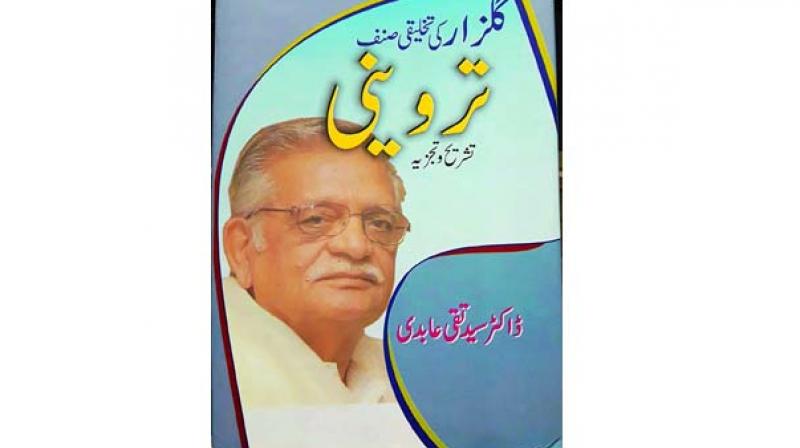
Gulzar enriches Urdu with Triveni


Urdu poetry is now richer by a new genre, Triveni. The credit goes to filmmaker and lyricist Gulzar.
    A poetic unit of three verses, Triveni packs a punch in the last line by turning around the meaning expressed in the first two verses.
    Gulzar, who has mastered the art of writing the Triveni, regaled the audience the other day at the Maulana Azad National Urdu University (Manuu).
    What was billed a seminar turned into a mushaira with the renowned poet holding everyone spellbound with his three-liners. Right from Vice-Chancellor Aslam Parvaiz to professors and students, Gulzar’s recital swept everyone off their feet.
   A book penned by Canada-based Hyderabadi scholar Dr Syed Taqi Abidi, Gulzar ki Taqleeqi Sinf, Triveni, Tashreeh o Tajziya was released on the occasion.         
    Three-line poetry is not new to Urdu language.
    There are various forms like the musallu, the haiku, tikoni, salees and the tipai where an idea is expressed in three lines. But Triveni differs in that it’s free from the restrictions of radeef and qafia (rhyming).
    The thought expressed in the first two lines takes a new twist when the third line is read.
    For the last few years, Gulzar has been writing Trivenis on subjects as varied as love, the calamities of life, social milieu and moral values.
    The best part of Gulzar's shayeri is that one doesn't need to consult a dictionary. His poetry is simple and down to earth. What’s more, he doesn’t hesitate to borrow commonly used English
    Asked why he named his three-line verse Triveni, Gulzar said the first two verses meet like the Ganga and the Jamuna and complete a thought and an emotion. But beneath these streams runs another river, the Saraswati, which is apparently hidden. He likens the Triveni’s third line to the Saraswati which makes a world of difference.

Sample this triveni:

Samne aye mere, dekha mujhe, baat bhi ki
Muskuraye bhi purani kisi pehchan ki khatir
Kal ka akhbar tha, bas dekh liya, rakh bhi diya
(You come before me, acknowledge me, and even talk to me
Your smile reveals our long acquaintance
Like yesterday’s newspaper, read and discarded) 

   At a time when Urdu readership is dwindling, Gulzar remains its face.
In his own inimitable way, he is trying to keep the flickering flame burning. He wants the language to be made simpler for Hindi readers.
    He superbly captures the dilemma facing Urdu thus:
Badi aristocracy hai zaban main Faqeeri mein, nawabi ka maza deti hai .

J.S.Ifthekhar,
Hyderabad based journalist.

Article published in Deccan Chronicle
Dated November 25,2018
.

Monday, November 19, 2018

News, rumours about a Hyderabad icon

The place remains chaotic, loud and as frenzied as ever.

The place remains chaotic, loud and as frenzied as ever. But there is a pleasant change now. You can breathe easily and appreciate your favourite monument without the fear of being knocked down. Tourists visiting Charminar are now whistling their relief. They can have a leisurely dekho of the historic edifice.

For years Hyderabad’s most popular icon was stuck in a time warp. Reaching it involved navigating obstacles and potential hazards from potholes to throngs of distracted pedestrians—not to mention automobile fumes and the swirling traffic. Every time I went there I had to literally fight for space. Not anymore. Now you can saunter around, popcorn in hand, and look at the architectural wonder raised to ward off recurring plague. Thank God the Charminar Pedestrianisation Project being implemented in fits and starts is at last showing results.

My friend from Chennai who recently visited Charminar couldn’t believe his eyes when he could move around the monument at an unhurried pace and take selfies without the fear of honking traffic. Driving through Charminar is still not easy. You have to pick your way past the street-level chaos peculiar to the old city of Hyderabad. If one can ride here, one can ride anywhere goes a popular saying.

But this doesn’t deter visitors. For tourists a visit to Hyderabad remains incomplete without a visit to Charminar. The same is the case with the locals. Come festivals or marriage season shopping around the monument is must. A bride’s trousseau is incomplete without a visit to Laad Bazar, the famed bangle street.


Politicians have their own reasons to root for Charminar. They find it the best place to stage protests and take out rallies. That’s not all. There are many myths associated with Charminar. For rumour mongers there is nothing like the ‘Charminar ki pudi’ to set afloat idle gossip. Sometime ago, archaeologists too fell prey to it and dug up a major portion of the road from the monument in the hope of uncovering a secret tunnel connecting it to the Golconda Fort. But in the end it turned out to be nothing more than a ‘Charminar ki pudi’.

J.S.Ifthekhar,
Hyderabad based journalist.

Article published in The New Indian Express
Dated November 19,2018


Sunday, November 18, 2018

A poet who defies definition

Saeed Shaheedi, poet of 'Barq-o-Aashiyan', excelled in all genres of poetry. A tribute to the prolific writer

There is no dearth of poets in Hyderabad. But, he remains a cut above the rest. You can rock to his romantic ghazals and also sob to his soulful dirges. That’s Saeed Shaheedi for you. A poet who defies definition.
A prolific writer, Saeed has left his stamp in all genres of Urdu poetry – Ghazal, Qasida (panegyric), Naath (eulogy of the Prophet), Manqabat (sufi devotional poem), Rubai (quatrain), Munajaat (supplication), Salam (salutation), Marsia (elegy) and Noha (lamentation). He carved out a special niche for himself as versifier of Ahl-e-Bait. His devotional poetry written in praise of the Prophet’s family is a big draw during the Muharram mourning sessions. Saeed is equally popular for his ghazals where he is at his best depicting the feelings of love and bereavement.

Born Mir Abid Ali, he is known by the nom de plume Saeed. During his lifetime, he figured among the show stealers. His style of rendition apart, the profundity of thought, the pungent freshness, poignancy and music in his verses cast a mesmerising spell. The effect is much the same even now as the poet himself remarked once:

Jab bhi mehfil main chidi meri ghazal
Sari mehfil ko tadapta dekha

(Whenever my ghazal is recited/ The entire assemblage is seen in spasm)

What is unique about this Shayer-e-Deccan is that he could express exquisite sentiments with beauty, ardour and pathos in short beher (meter). His lyrical power is extraordinarily versatile and renders the whole gamut of human emotions with consummate felicity. Most of his ghazals betray a nostalgic longing for the beloved. Sample these verses:

Kaise sukoon paoon tujhe dekhne ke baad
Ab kya ghazal sunaoon tujhe dekhne ke baad
Teri nigah-e-mast ne maqmoor kar diya
Kya maikadh ko jaoon tujhe dekhne ke baad          

 His ghazals are distinctive and moving. Using elegant vocabulary and metaphorical allusions, Saeed is able to express different shades of feelings while adhering to rhyme and meter. See how in this ghazal he plays on words and emotions which he alone could do.

Kis ko pane ki baat karte ho
Hosh udane ki baat karte ho
Jam khali laga ke honton ko
Ladkhadane ki baat karte ho

Known as poet of ‘Barq-o-Aashiyan’, Saeed’s shayeri is full of references to lightning and nest. He employs these metaphors superbly in different contexts to depict the ravages suffered by a hapless lover at the hands of the beloved and to cock a snook at destiny.

Barq ke liye kya kya zahmaten uthata hoon
Aashiyan ke jalte hi aashiyan banata hoon
Aashiyane ki bunyad rakh ker Saeed
Barq ka housla azmate hain hum

 It is difficult to gauge the depth of his poetry as he mastered the art of expressing difficult situations in an easy way. The agony of Karbala, the most poignant chapter in Islamic history, has a bearing on his poetry. No wonder his verses have the sensation of smouldering embers. But, they don’t scorch the readers and listeners – rather bestow the warmth of life upon them. Saeed surely is one of a kind. This is best summed up in his own words:

Ghalib nahin main phir bhi Saeed itna kahoonga
Har ek se hat kar mera andaze bayan hai

Poetry runs in his genes with his father, Mir Mehdi Ali, being a poet himself. Saeed gave a hint of his brilliance when he took part in the annual mushaira held at Nizam College as a student. Those present, including the then Prime Minister Maharaja Kishan Prasad, couldn’t miss the great poet in the making.

Mubtalaye zulf ghabrate nahin
Khelte hain khaid mein zanjeer se          

Though Saeed worked in the Excise Department, he remained a poet at heart. He was bestowed the title of said-us-shora and travelled widely addressing poetic sessions both within and outside the country. His poems were regularly broadcast from All India Radio and BBC. Perhaps, Saeed had an inkling of his fame and said it in a subtle way in this couplet:

Aankhen khul jaayengi zamane ki
Meri aankhen to bund hone do

There could be no better tribute to this master poet than publication of his complete works. Another great son of the soil, Dr Syed Taqi Abedi, deserves compliments for bringing out the Kuliyat-e-Saeed Shaheedi to mark his birth centenary celebrations held on January 23, 2018.  A collector’s issue, the 759-page tome contains all the 3,869 verses composed by him along with the views of top writers.

J.S.Ifthekhar,
Hyderabad based journalist.

Article published in Telangana Today
Dated November 18,2018

Popular Posts

New1